

The mistake almost everyone makes with an empty bedroom
You move in, the room is bare, and the first thing you do is fall down a rabbit hole of aesthetic Pinterest boards. Two hours later you've bookmarked a lamp, a mirror, three throw pillows, and a rug — but you still don't have a bed frame. It happens constantly, and it's a budget killer.
Decor is seductive because it's the fun part. But if you spend your furniture budget on looks before you've covered the basics, you end up sleeping on a mattress on the floor for three months while a very stylish lamp sits in the corner. This post is about avoiding exactly that — by buying in the right order.
Step 1: The bed frame (yes, before anything else)
The bed is the functional anchor of the whole room. Everything else — storage, layout, lighting — gets arranged around it. So the frame comes first, full stop.
When you're choosing a frame on a limited budget, prioritize two things: size and sturdiness. Get the largest size that fits your room comfortably, because downsizing later is a frustrating and expensive correction. A full-size frame in a room that could handle a queen will feel cramped within six months. Measure your room before you look at anything.
Also check whether the frame requires a box spring or works with a platform design. Platform frames sit lower and support a mattress directly — no box spring needed, which saves money. If you're buying a frame and a mattress at the same time, knowing this upfront means you're not accidentally budgeting for three pieces when you thought you were buying two.
Step 2: Mattress support — get this right before anything else is comfortable
If your frame needs a box spring or foundation, buy it at the same time as the frame. This is not optional. A mattress sitting directly on a frame that requires support will sag in the middle within months, and mattress warranties are often voided by improper support. It's a boring purchase, but skipping it costs you more later.
If you went with a platform frame, you're already done with this step — move on.
Step 3: Storage — before you unpack, not after
Here's where most people lose the plot. They get the bed sorted, breathe a sigh of relief, and then live out of boxes and laundry baskets for weeks while they decide on a dresser. Don't do this.
Storage should be your very next purchase after the bed is set up — ideally before you've fully unpacked. A dresser or chest of drawers gives you a place for clothes, which means the floor stays clear, which means the room actually functions as a room and not a storage unit you happen to sleep in.
You don't need a full matching bedroom set. A single dresser with enough drawers for your clothes is enough to start. Nightstands can wait. A wardrobe can come later if you need one. The goal at this stage is functionality, not a coordinated look.
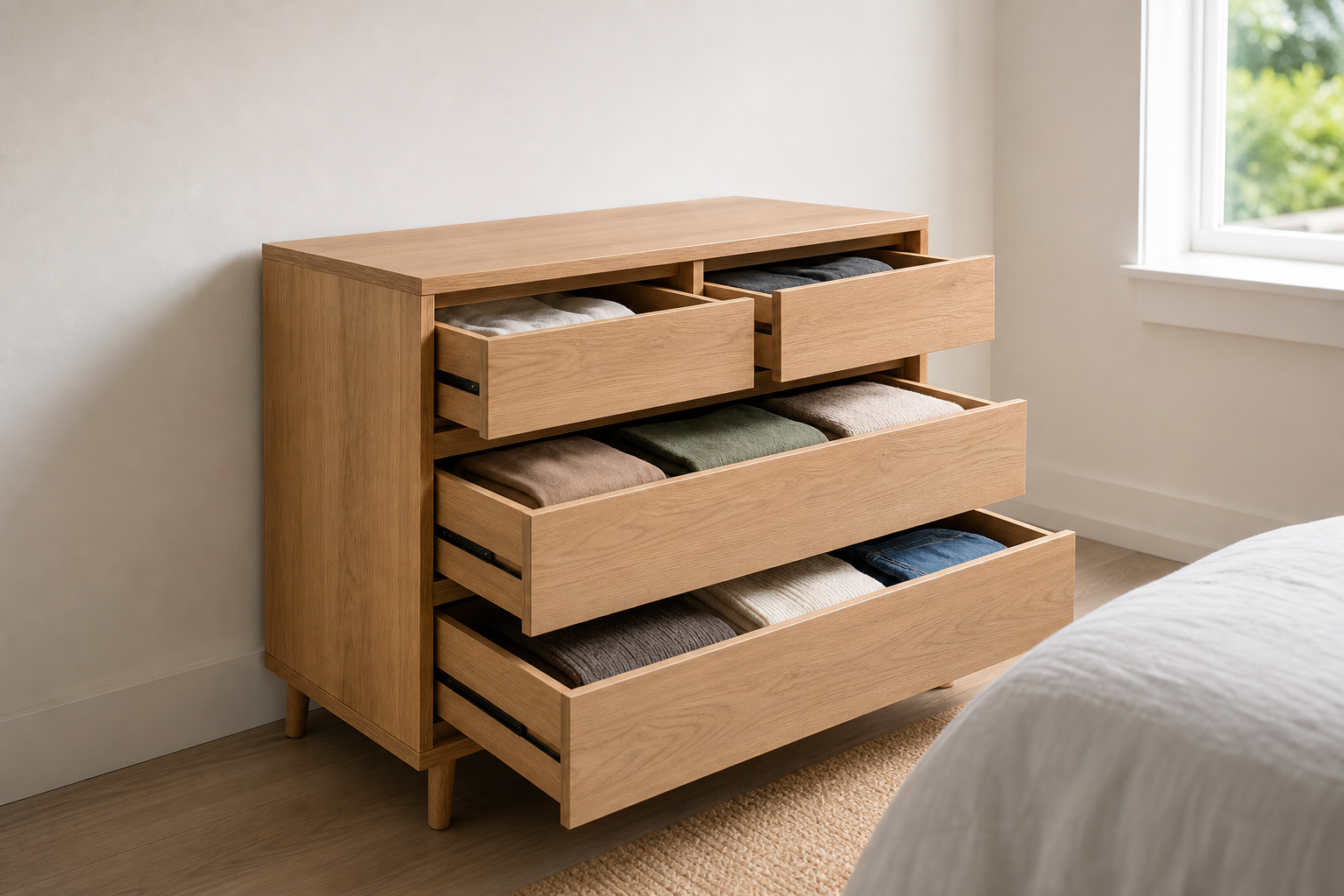
Step 4: Nightstands — useful, but not urgent
Nightstands are genuinely useful: a place for a phone, a glass of water, a book. But they are not critical in the way a frame or dresser is. If your budget is tight after steps 1–3, a nightstand can wait a few weeks without any real consequence.
When you do buy one, you don't need a matched pair. One nightstand on the side you actually use is completely practical, and a second can follow when the budget allows. Nobody will notice the asymmetry as much as you think they will.
Step 5: Lighting — the most underrated functional purchase
Overhead lighting in most rental bedrooms is either harsh or nonexistent. A bedside lamp or a floor lamp in the corner transforms how the room feels in the evening — and it's usually one of the more affordable additions you can make.
Buy lighting before you buy decor. It's functional (you need to see at night without flipping the main light on) and it does more for the atmosphere of a room than most decorative items at the same price point.
Step 6: Decor — now you've earned it
Once you have a frame, support, storage, and a light source, your bedroom works. You're sleeping well, your clothes have a home, and the room is functional. Now decor actually makes sense to think about.
A rug, some wall art, throw pillows — these are the finishing layer, not the foundation. Buying them in this order means you're choosing decor to complement a room that already functions, rather than trying to make a half-furnished room look intentional with accessories.
It also means you're spending decor money when you have leftover budget, not competing with it against the essentials.
A quick note on buying in stages
If your budget is genuinely tight, it's completely fine to furnish a bedroom over several weeks or even months. The sequencing above tells you what to prioritize when money is limited. You don't need to buy everything at once — you need to buy things in an order that means you're always sleeping comfortably and functioning day-to-day, even if the room isn't finished yet.
If you're buying furniture online for the first time and want to know what else to check before you commit — dimensions, return policies, assembly requirements — this guide on buying furniture online for the first time covers exactly that.
The short version
- Bed frame — buy this first, size it right, check what support it needs
- Box spring or foundation — only if your frame requires it
- Dresser or storage — before you unpack, not after
- Nightstand — useful, but can wait a few weeks
- Lighting — more functional than it seems, buy before decor
- Decor — rugs, art, pillows — the finishing layer, not the starting point
A bedroom that works comes before a bedroom that looks good. Get the sequence right and you'll end up with both.
Browse beds, frames, and bedroom furniture built for every budget at selectfurniturestore.com — free shipping on every order.
Frequently Asked Questions
Do I need a box spring if I buy a platform bed frame?
No — platform frames are designed to support a mattress directly, so a box spring isn't needed. This is one reason platform frames can be a budget-friendly choice: you're buying one piece instead of two. Just confirm the frame you're buying is specifically described as a platform design before skipping the box spring.
Is it worth buying a matching bedroom set, or should I buy pieces separately?
Matching sets look cohesive, but they're often more expensive upfront and lock you into buying pieces you may not need right away. Buying separately lets you prioritize what you actually need first and fill in the rest over time. If a set genuinely covers all your needs at a price that fits your budget, it can be worth it — but don't buy a set just because it matches.
What size bed frame should I get for a small bedroom?
Measure your room before you decide. A common mistake is defaulting to a smaller size to "save space," then regretting it once the room is set up. In general, a queen fits most standard bedrooms comfortably and is worth the extra room if the dimensions allow it. Measure the floor space, account for walking clearance on at least two sides of the bed, and then decide — don't guess.
Can I furnish a bedroom in stages, or do I need to buy everything at once?
Absolutely — furnishing in stages is a smart approach when you're on a budget. The key is buying in the right order so your room is always functional, even when it's not fully finished. Start with the bed frame and support, add storage next, then work through lighting and eventually decor as your budget allows. A room that works is better than a room that's half-styled but missing the basics.