

The photo looked perfect. Then it arrived.
You ordered the sofa because it looked proportional in the listing. Clean lines, not too bulky, just the right vibe. Then it showed up and took over half the living room. The product page said the dimensions were right there — you just didn't know how to translate them into your actual space from a screen.
That's the specific problem with shopping for small-space furniture online. It's not a lack of options. It's that the whole experience is designed for rooms bigger than yours. Staged photos use wide-angle lenses. Showrooms have 12-foot ceilings. And "compact" means something different on a product page than it does in a 400-square-foot apartment.
The good news: there's a process that actually works, and once you run through it a couple of times, it becomes second nature.
Step 1: Tape your floor before you open a single product page
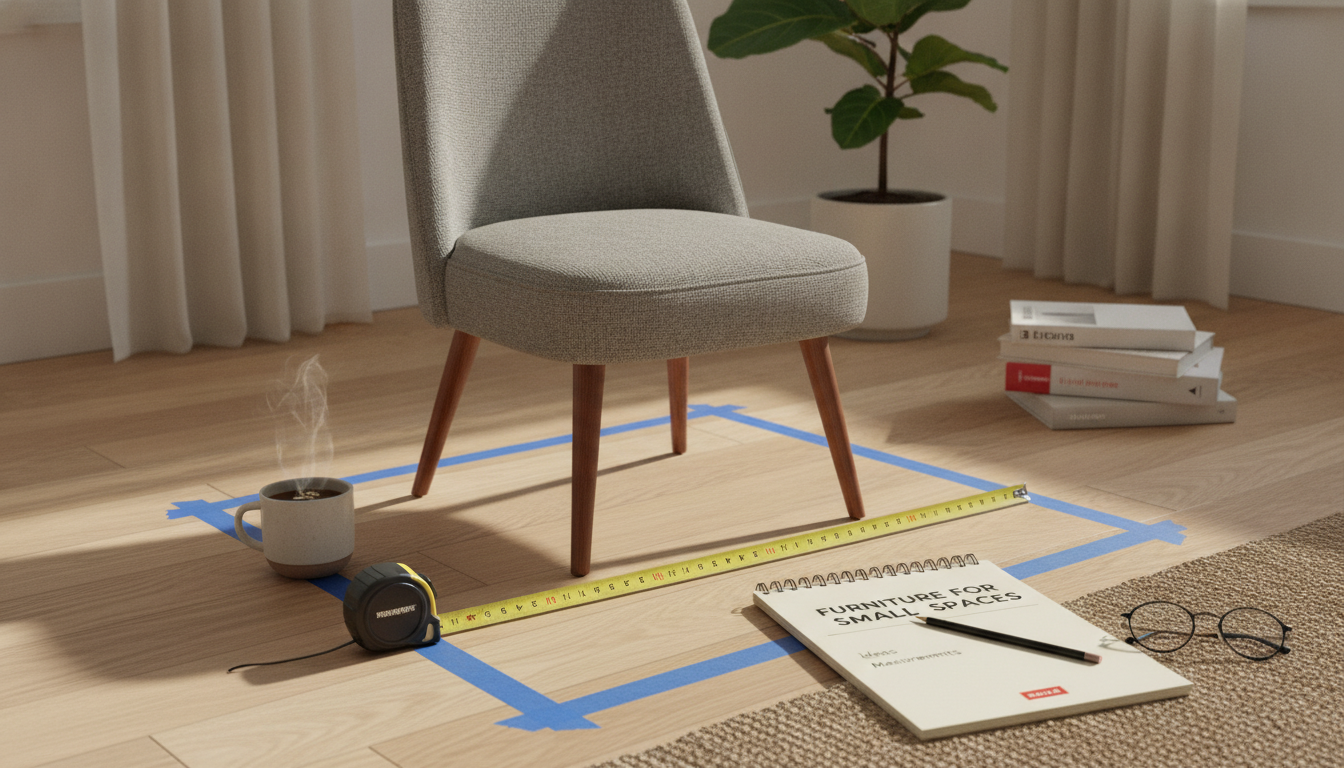
This sounds obvious. Almost nobody does it. Before you start browsing, grab a tape measure and mark out the footprint of the furniture you're replacing or adding — use painter's tape right on the floor. Stand in the room and look at it. Walk around it. That rectangle on the floor is the single most useful tool you have, and it costs nothing.
The number you're protecting isn't just the furniture's width. It's the clearance around it. A standard traffic lane through a room needs roughly 36 inches of clear walking space. Between a coffee table and a sofa, 18 inches is a functional minimum — less than that and you're constantly bumping your shins. Mark those lanes too.
Now you have a real target: not just "I need a sofa under 90 inches," but "I have 84 inches of wall, need 6 inches of breathing room on each side, and 18 inches in front for the table." That's a spec, not a wish.
Step 2: Know which numbers on a product page actually matter
Product listings typically give you overall width, depth, and height. For small spaces, depth is the dimension most people underestimate. A sofa that's 85 inches wide might fit your wall — but if it's 38 inches deep, it eats into your floor space more than a 90-inch sofa at 32 inches deep.
A few numbers worth pulling for each furniture category:
- Sofas and chairs: Overall depth (wall to front of cushion), seat height (matters for tight spaces under windows or low shelves), and arm height if you're pairing it with a side table.
- Coffee tables: Height relative to your sofa's seat height — ideally within a couple of inches of the seat. Too tall and it feels cramped; too low and it's just awkward.
- Beds and frames: Check if the listed size is the mattress size or the frame's outer footprint. They're different. A queen mattress is 60 × 80 inches; the frame around it adds several inches on each side.
- TV stands and media furniture: Weight capacity and interior shelf height matter as much as the outer dimensions — especially if you're stacking components in a tight corner.
If a product page is missing a dimension you need, check the assembly manual PDF if one is linked, or contact the retailer before ordering. A missing spec is a reason to pause, not a reason to guess.
Step 3: Sanity-check the photo
Wide-angle lenses make rooms look bigger. This isn't deceptive exactly — it's just how product photography works. But it means the sofa that looks perfectly scaled in a lifestyle shot might be a monster in your actual room.
Here's a quick test: look for a reference object in the photo you can size. A standard interior door is 80 inches tall and 32–36 inches wide. A light switch plate is about 4.5 inches tall. If the photo includes either, you can roughly judge whether the furniture's stated dimensions match what you're seeing — and whether the room in the shot is plausibly the same size as yours.
If the photo shows the piece in a room that's clearly enormous, mentally discount the "it looks right-sized" instinct. Go back to your tape-measure spec and trust the numbers instead.
Which furniture categories are most forgiving in small spaces
Not all furniture is equally risky to buy online for a tight room. Some categories have more flexibility built in.
Armchairs and accent chairs are the most forgiving. A chair that's slightly larger than expected can usually be repositioned without ruining the room. It's also easier to judge scale from a single-seat piece than from a sectional.
End tables and side tables are low-risk because their footprint is small and they're easy to move. Focus on height compatibility with your sofa or bed, and you're mostly fine.
TV stands are medium-risk. Width is usually easy to verify against your TV size and wall, but depth and the height of interior shelves trip people up more often than they expect.
Sofas and sectionals are the highest-stakes purchase in a small space. If you're buying one online, spend extra time on the dimensions, use the tape-on-floor method, and check the return policy before you commit. A sectional with a chaise is almost always a harder fit than it looks in photos — measure the chaise extension separately.
Beds and frames are medium-risk if you know your mattress size and measure your room carefully. The detail most people miss: clearance on the sides and at the foot of the bed. You need enough room to actually make the bed and move around it.
A few small-space furniture principles that hold up
Beyond the measuring process, a handful of design principles genuinely help in tight rooms — not because they're stylish, but because they're practical.
Legs over skirts. Furniture with visible legs (versus pieces that sit flush to the floor) makes a room feel less heavy because you can see the floor beneath it. This is especially true for sofas and chairs.
Fewer, larger pieces beat many small ones. A room full of small furniture reads as cluttered. One well-chosen sofa and a single coffee table will feel more spacious than a sofa, two armchairs, an ottoman, and a side table crammed in together.
Multifunctional beats single-use. An ottoman with storage, a bed frame with drawers, a media console that doubles as a credenza — in a small space, every piece should earn its footprint by doing more than one job.
Light colors and open backs aren't magic, but they help. A bookcase with an open back or a glass-top coffee table doesn't actually take up less space, but it interrupts sightlines less, which makes the room feel less blocked.
Before you check out: one last step
Read the return policy. Not the summary — the actual policy. Know whether large furniture ships via freight (which often requires someone to be home for a delivery window), whether returns are free or have a restocking fee, and how long you have to initiate one. For small-space shoppers, a generous return window isn't a luxury; it's part of the purchase decision.
If you're buying furniture online for the first time and want a broader checklist of what to verify before adding anything to your cart, this guide on buying furniture online for the first time covers the full pre-purchase process.
Small spaces reward patience. The right piece — the one you measured twice and confirmed on paper before ordering — will feel like it was made for the room. The wrong one will feel like it's always in the way, no matter where you put it.
Find pieces sized for real rooms — shop Select Furniture with free U.S. shipping and a catalog built for every room size.
Frequently Asked Questions
How do I know if a sofa will fit through my apartment door before it arrives?
Measure your doorway's width and height, then check the product page for the sofa's diagonal depth — that's the measurement you need when tilting a piece through a doorway. Also note whether the sofa ships assembled or in sections; many sofas arrive with legs detached, which makes delivery significantly easier in tight hallways and stairwells. If you're unsure, contact the retailer before ordering.
What's the minimum room size for a queen bed with a frame?
A queen mattress is 60 × 80 inches, but the frame adds a few inches on each side. As a general guideline, a 10 × 10 foot room is considered the practical minimum for a queen bed with enough clearance to walk around it and open dresser drawers. In a room that tight, a bed frame without a footboard and with under-bed storage drawers will serve you far better than a traditional frame with a full footboard.
Are "apartment size" or "compact" labels on furniture actually standardized?
No — there's no industry-wide standard for what qualifies as "apartment size" or "compact." These labels are set by individual manufacturers and can vary significantly. Always go straight to the listed dimensions rather than relying on a size label, and compare those numbers against your taped floor measurement. The label is a starting filter, not a guarantee of fit.
Is it worth using a room planning app before buying furniture online?
Yes, for larger purchases it's genuinely worth the few minutes it takes. Free tools like Ikea's room planner or similar apps let you input your room's dimensions and drop in furniture to scale. They're not perfect, but they'll catch obvious problems — like a sectional that blocks a doorway — before you commit. Pair the app with your physical tape-measure test on the floor for the most reliable read on fit.