

The real reason small living rooms feel cramped
It's rarely the room's fault. Most small living rooms feel stuffed not because they're tiny, but because the furniture in them was sized for a room twice as large. A sofa that's a few inches too long, a coffee table that eats the walkway, a TV stand that dominates an entire wall — each piece seems fine on its own, but together they turn a cozy space into an obstacle course.
The good news: fixing this is mostly a measuring problem, not a decorating problem. Once you understand which dimensions actually matter and which pieces earn their square footage, a compact living room can feel intentional rather than squeezed.
Start with the sofa — it sets everything else
The sofa is almost always the biggest footprint in a living room, which means it's also the biggest mistake when it's the wrong size. Before you fall for a sectional because it looks great in a showroom, measure your wall and your walkways.
A general rule that holds up: you want at least 30–36 inches of clear walkway between the sofa and any opposite wall or piece of furniture. That's enough for two people to pass comfortably. If your sofa leaves less than that, the room will always feel tight no matter what else you do.
For small living rooms, a two-seat or compact three-seat sofa with a lower profile tends to work better than a deep, high-backed sectional. Lower backs make the room feel more open because you can see more wall above the furniture. Legs also help — a sofa that sits on visible legs reads as lighter than one with a solid base that goes straight to the floor.
Avoid: oversized sectionals with a chaise, sofas deeper than 36 inches, and anything with wide arms that eat into the seating width without adding comfort.
The coffee table question everyone gets wrong
Most people buy a coffee table to match the sofa, then wonder why the room feels like a maze. The shape and size of your coffee table should be driven by the space between your sofa and your opposite wall — not by what looks good in a catalog photo.
Leave at least 16–18 inches between the sofa and the coffee table so you can reach it comfortably without leaning off the edge of the cushion. Then leave another 18 or so inches between the table and whatever is across from it — a TV stand, a chair, or the wall. If those numbers don't add up in your room, the table is too big.
Round and oval coffee tables are genuinely better for small rooms. They eliminate sharp corners that catch your shins and visually soften the space. Nesting tables are another strong option — use both when you need them, tuck one away when you don't.
If storage is tight, a coffee table with a shelf or lift-top lid earns its place twice over. Just don't let it become a dumping ground, or the visual clutter undoes everything the smaller footprint gained you.
Which pieces actually pull double duty
In a small living room, every piece of furniture should justify itself. The ones that do two jobs without taking up more space than a single-purpose piece are worth prioritizing.
- Storage ottomans — footrest, extra seating, and hidden storage in one. Swap out a bulky coffee table for a large storage ottoman with a tray on top and you've reclaimed meaningful floor space.
- Slim console tables — placed behind a sofa or against a wall, they add a surface without projecting far into the room. Useful for lamps, books, or decorative objects that would otherwise sit on the floor.
- Lift-top coffee tables — the surface raises to desk or dining height, which matters if your living room is also where you work or eat.
- Armless accent chairs — they seat a guest without the visual bulk of a full armchair. Move them out of the way easily when you need the floor space.
What to skip: matching three-piece sets that include pieces you don't need, oversized entertainment centers that run wall-to-wall, and side tables that are too wide to actually be side tables.
How to lay out the room before you buy anything
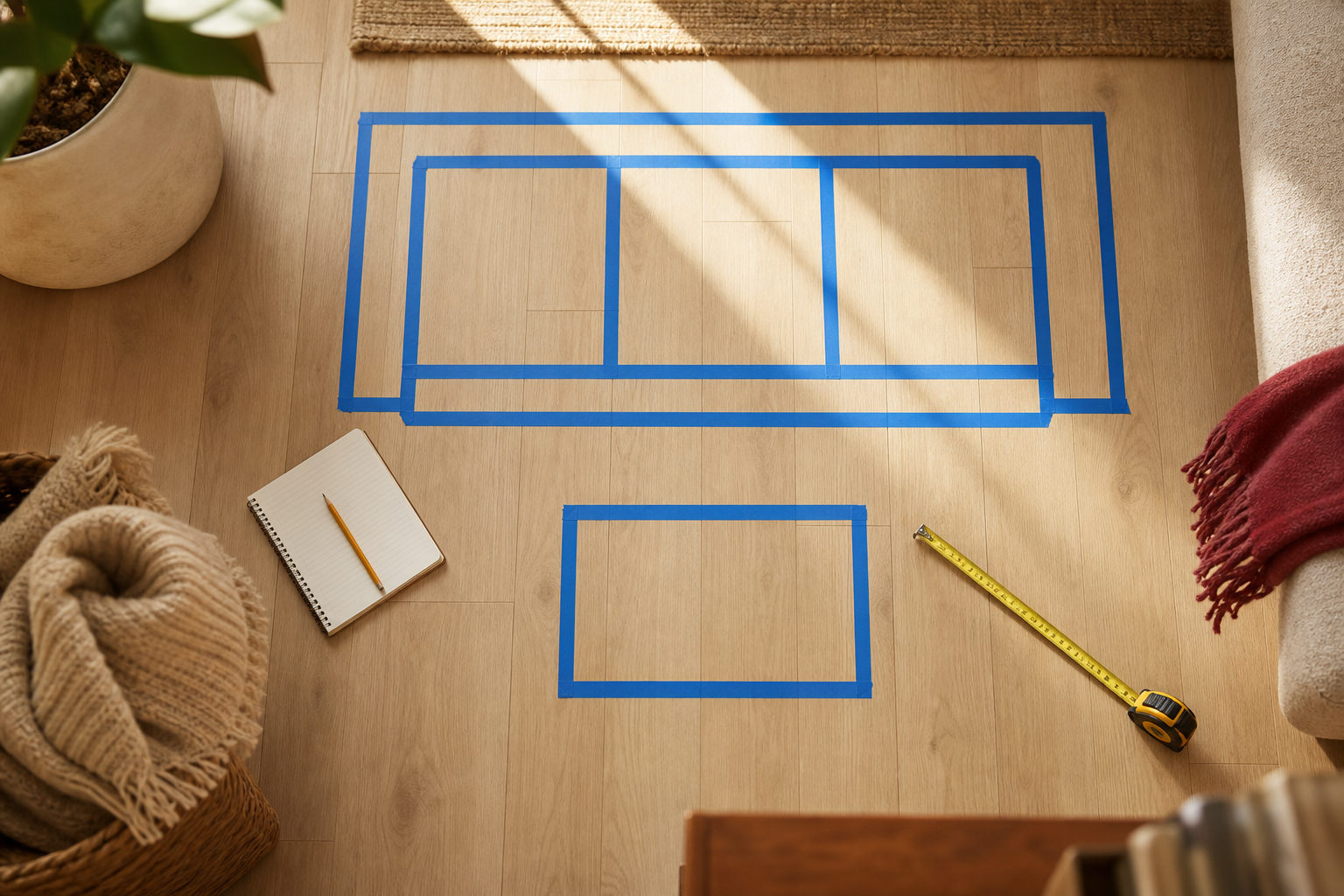
This is the step most people skip, and it's the one that would save them the most money in returns. Before ordering a single piece, tape out the footprint of each item on your floor using painter's tape. Measure the actual sofa dimensions, tape that rectangle on the floor, then walk around it. Add the coffee table. Add the TV stand. Live with the tape for a day.
You'll immediately see if a walkway is too tight, if the seating area feels cut off from the rest of the room, or if you've left a dead corner that could hold a small bookcase or floor lamp instead.
Also measure your door frames and hallway widths before you buy. A sofa that fits the room but can't get through the front door is a common and avoidable problem — check the delivery path, not just the destination.
If you're buying furniture online for the first time and want a fuller checklist of what to verify before you order, this guide on buying furniture online for the first time covers the key things to confirm before you add to cart.
Color and visual weight matter more than you think
Furniture that's physically compact can still feel heavy if it's the wrong color or material. Dark, solid upholstery in a small room tends to advance visually — it makes pieces look larger and closer. Lighter neutrals, natural wood tones, and furniture with open frames (visible legs, open shelving) recede and give the room more breathing room.
That doesn't mean everything has to be white or beige. One anchor piece in a deeper color — a navy sofa, a walnut coffee table — can ground the room without overwhelming it, as long as the surrounding pieces stay lighter and lower in profile.
Mirrors are a legitimate trick, not a cliché. A large mirror on the wall opposite a window genuinely doubles the apparent depth of a room by reflecting light and space. It's one of the few decorating moves that works every time in a small living room.
The short version
Measure before you browse. Give every piece of furniture a job. Prioritize legs, lighter colors, and round edges. And when in doubt, go one size smaller than you think you need — you can always add a piece, but you can't add floor space.
A small living room done right doesn't feel like a compromise. It feels considered.
Browse sofas, coffee tables, and multi-use living room pieces sized for real-world spaces at Select Furniture — free shipping on every order across the USA, with easy returns if something doesn't work in your space.
Frequently Asked Questions
What sofa size is best for a small living room?
A compact two-seat or three-seat sofa with a lower back profile and visible legs tends to work best. The key measurement is the walkway — aim to leave at least 30 inches of clear floor space between the sofa and anything across from it. Measure your wall before you decide on a length, and check that the sofa can physically get through your front door and hallway before ordering.
Should I avoid sectionals in a small living room?
Most full-size sectionals — especially those with a chaise — are designed for larger rooms and will dominate a small space. That said, some compact sectionals are built specifically for tighter footprints, so the answer isn't a blanket no. Check the total width and depth measurements carefully, tape them out on your floor, and make sure the chaise or corner piece doesn't block a doorway or natural walkway through the room.
Is a round or rectangular coffee table better for a small space?
Round and oval tables generally work better in small living rooms. They eliminate sharp corners (which catch shins and feel obstructive), and their curved silhouette visually softens the room. Nesting tables are another strong option — they give you extra surface when you need it and tuck away when you don't, keeping the floor clear the rest of the time.
How do I make a small living room look bigger without knocking down walls?
Three things make a consistent difference: furniture with visible legs (it shows floor beneath the pieces, making the room feel less blocked), lighter upholstery and wood tones (dark pieces visually advance and feel heavier), and a large mirror on the wall opposite a window. Beyond that, keeping the floor as clear as possible — no furniture pushed tight against every wall, no unnecessary pieces — does more for the feeling of space than any paint color or decorative trick.