

You've probably seen the words wabi-sabi and japandi on product listings and thought — okay, but what does that actually mean for the thing sitting in my living room? It's one of those aesthetic labels that sounds meaningful until you try to picture it on your specific sofa, in your specific apartment.
So let's make it concrete. The Chenille Sofa Cover Throw Blanket is a good worked example, because it's the kind of piece where every design decision — the texture, the color, the trim — is a direct expression of that minimalist wabi-sabi philosophy. Once you see why, you'll know instantly whether it belongs in your space.
What Wabi-Sabi Actually Means (in Plain Terms)
Wabi-sabi is a Japanese concept rooted in finding beauty in imperfection, impermanence, and natural simplicity. In furniture and home décor, that translates to: rough-over-smooth, natural-over-synthetic, quiet-over-loud. It's the opposite of high-gloss and perfectly symmetrical. A wabi-sabi room feels like it grew into itself rather than being assembled from a showroom floor.
Japandi — a blend of Japanese and Scandinavian design — shares the same instinct: neutral palettes, honest materials, functional simplicity. The two aesthetics overlap heavily, which is why you'll often see them paired on the same product page.
Neither of these is a trend in the fast-fashion sense. They're a disposition toward the home — one that tends to age very well.
What This Sofa Cover Actually Looks Like
The chenille throw in the photo is a warm beige-taupe — not stark white, not grey, but that specific in-between tone that reads as natural and grounded. It's the color of undyed linen or raw cotton, which is exactly the point.
The surface has a visible grid-like woven pattern. Look closely and you can see the structure of the fabric — the way the chenille threads cross and build a chunky, dimensional texture. It doesn't pretend to be flat or uniform. That visible weave is the wabi-sabi element made physical: the beauty is in the craft, not in hiding it.
Along the edges, there's a tassel fringe trim. It's a small detail, but it does a lot — it softens the line where the cover meets the floor or the sofa arm, and it adds a handmade quality that plain hemmed edges don't have.
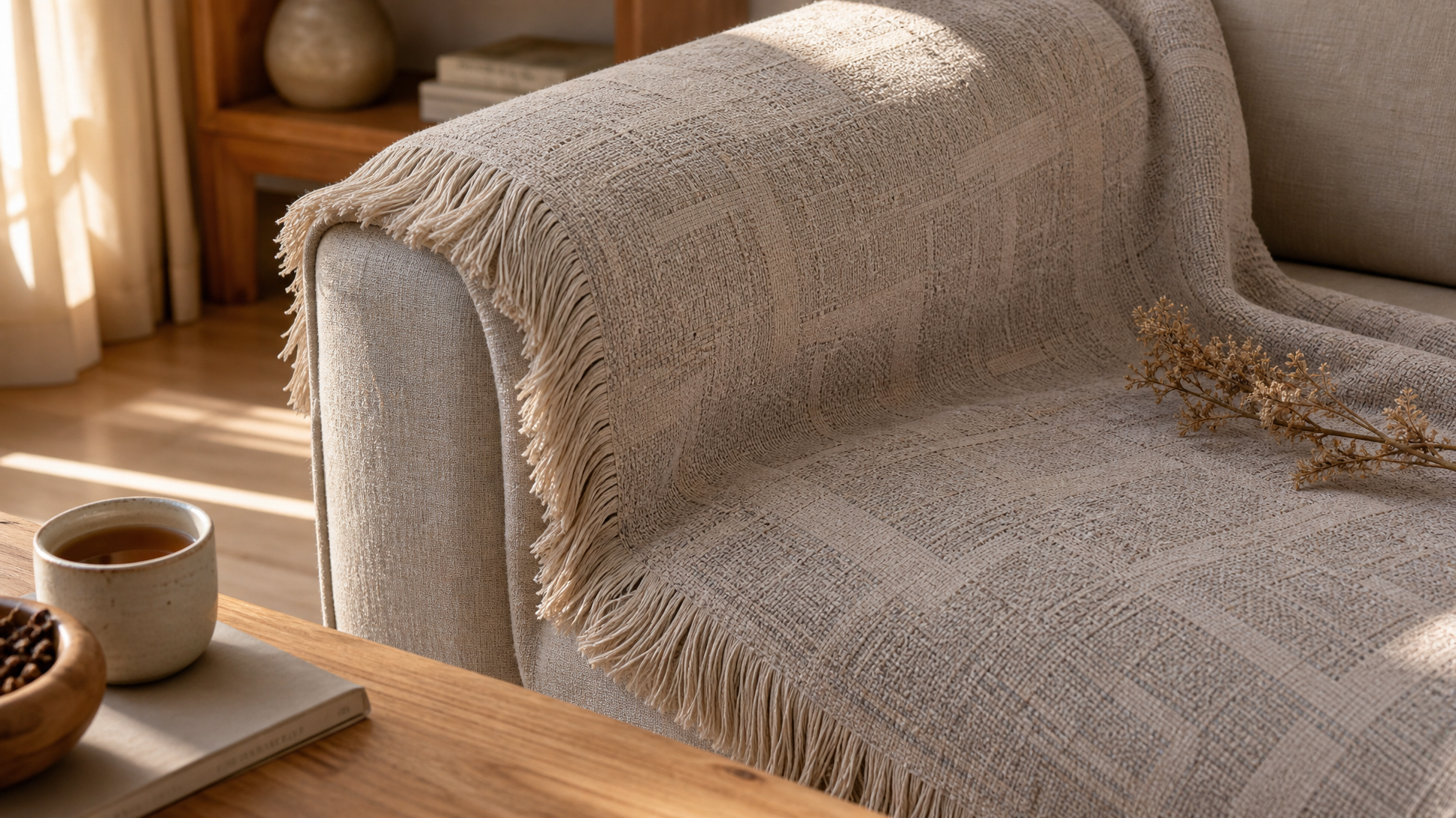
Draped over a sofa, it doesn't look like a protective cover. It looks like a considered design choice. That's the practical magic of this particular piece.
What It Actually Does for Your Sofa
The aesthetic side gets most of the attention, but the functional case is just as strong — especially if you have pets, kids, or a sofa that's seen better days.
The chenille fabric is thick and textured, which means it sits with some weight and doesn't slide off the moment someone sits down. It's made to be soft and breathable against skin, so it doesn't feel like a tarp — it feels like a throw blanket you actually want to curl up under. And because it's machine washable, a muddy paw print or a spilled coffee isn't a crisis.
The other practical advantage over fitted slipcovers: installation takes seconds. You drape it, tuck it where you want it, and you're done. No wrestling with elastic corners or zippers. And if your décor changes with the season — or you just want a refresh — you pull it off just as easily.
Does It Fit the Room You Already Have?
This is the real question, and the honest answer is: it depends on what your room is already doing.
The wabi-sabi chenille cover works best when your space already leans toward natural materials and neutral tones — think timber floors, rattan accents, linen curtains, terracotta or stone-toned walls. It doesn't need all of those; even one or two of those elements in a room will give it something to connect with. The beige-taupe palette is forgiving enough that it won't clash with most warm neutrals.
Where it's less at home: rooms built around jewel tones, maximalist pattern, or very sleek high-gloss furniture. The chunky woven texture and organic fringe are doing the opposite of what those rooms are doing, and the mismatch will read as accidental rather than intentional.
A good quick test — look at your sofa right now. If it's a solid neutral (cream, grey, oatmeal, tan, even a faded dark linen), this cover will likely look like it belongs. If the sofa is a bold color or a strong print, the throw will compete with it rather than complement it.
One More Thing Worth Knowing
The cover is resistant to fading and pilling, which matters more than it sounds. Chenille can pill with heavy use if the fabric quality isn't there — a pilled surface looks tired fast, and it undermines the whole relaxed-but-intentional look wabi-sabi depends on. The fact that this one is built to hold its texture over time means you're not buying a one-season fix.
It's also worth noting it works beyond the sofa. Draped over a reading chair or laid across the foot of a bed, it functions just as well as a cozy throw. That versatility is part of what makes it a genuinely useful purchase rather than a single-purpose decorative item.
If you've been meaning to do something about a tired sofa — or just want to shift the feel of your living room without moving any furniture — this is one of the lower-effort, higher-impact ways to do it. Shop the Chenille Wabi-Sabi Sofa Cover at Select Furniture — free U.S. shipping on every order.
Frequently Asked Questions
What is wabi-sabi style in home décor?
Wabi-sabi is a Japanese aesthetic philosophy that finds beauty in imperfection, natural textures, and simplicity. In home décor, it shows up as neutral palettes, handcrafted-looking materials, and organic shapes — the opposite of polished and perfectly uniform. Think raw linen, chunky weaves, and uneven textures that feel lived-in rather than showroom-fresh.
Will this sofa cover stay in place, or does it slip around?
The chenille fabric has a chunky, textured weave that gives it some natural grip and weight, which helps it stay put better than lightweight throws. That said, like any drape-style cover, heavy daily use may shift it — a quick re-tuck takes seconds. If you need a fully locked-in fit, a fitted slipcover is a different product category.
Can I use this on a sectional sofa?
Because it's a drape-style throw rather than a fitted cover, it can be used on sectionals — though coverage depends on the size of your sectional relative to the cover's dimensions. It works best when draped over one main section or used to cover the seating area and arms of a standard sofa. Check the product listing for available size options before ordering.
How do I wash and care for the chenille cover?
The cover is machine washable, which makes everyday care straightforward. For best results with chenille fabrics generally, a gentle cycle with cold water and low-heat drying helps preserve the texture and prevent pilling. Always check the care label on your specific cover for the manufacturer's recommended instructions.